

Key Takeaways
Quick answer
Crypto mining is how proof-of-work blockchains such as Bitcoin add new blocks. Specialised computers race to solve a puzzle; the winner publishes the block and collects new coins plus fees. It uses a lot of electricity, and US regulators have charged some “mining contract” offers as frauds.
- Mining is how proof-of-work blockchains like Bitcoin add new blocks: computers race to solve a puzzle that is hard to solve but easy to check.
- The winner of each block receives newly created coins plus the transaction fees in that block.
- Miners use specialised hardware and often join pools that share the work and split the reward.
- The US Energy Information Administration estimated crypto mining used 0.6% to 2.3% of US electricity, a preliminary range published in 2024.
- The SEC has charged mining-contract schemes that promised steady returns, including one where most investors paid for computing power that never existed.
What does a crypto miner actually do?
A blockchain needs a way to decide who gets to add the next block of transactions. In a proof-of-work system, that decision is made by a race. The US National Institute of Standards and Technology (NIST) puts it simply: “In the proof of work (PoW) model, a user publishes the next block by being the first to solve a computationally intensive puzzle.”
The computers taking part are called miners, though nothing is dug up. They collect waiting transactions into a candidate block, then try to solve the puzzle for it. The first to succeed broadcasts the block. Other computers check it and, if every transaction is valid, build the next block on top of it. That chain of linked blocks is the blockchain.
What is the puzzle miners are solving?
In Bitcoin, the puzzle is a guessing game. A miner repeatedly changes one number in the block (the nonce) and runs the block through a hash function until the result starts with a required number of zero bits. There is no clever shortcut: the only method is to keep guessing.
NIST explains why this works: “The puzzle is designed such that solving the puzzle is difficult but checking that a solution is valid is easy.” Finding an answer takes enormous trial and error; checking it takes one calculation.
The US Energy Information Administration (EIA) describes the network’s guessing speed as the hash rate: “the number of guesses or attempts to solve the cryptographic puzzle per second”. To keep blocks arriving about every 10 minutes as more machines join or leave, Bitcoin’s software resets the puzzle’s difficulty every 2,016 blocks.
How do miners get paid?
The Bitcoin whitepaper set up the incentive: the first transaction in each block creates new coins for whoever produced the block, and the transaction fees in the block are added on top. Bitcoin.org’s FAQ describes fees as one way to pay miners for their work.
The new-coin part, called the block subsidy, started at 50 BTC and halves every 210,000 blocks. From block 840,000 to block 1,049,999 it is 3.125 BTC. Our Bitcoin halving guide shows the full schedule.
Illustrative example: in that era, a block containing a hypothetical 0.2 BTC of fees would pay its miner 3.125 + 0.2 = 3.325 BTC. The 0.2 BTC is invented for the arithmetic; real fees change with demand for block space.
Only the producer of each block (or the pool it belongs to) receives that block’s reward. Everyone else has spent electricity on that round without being paid for it.
What hardware is used for mining?
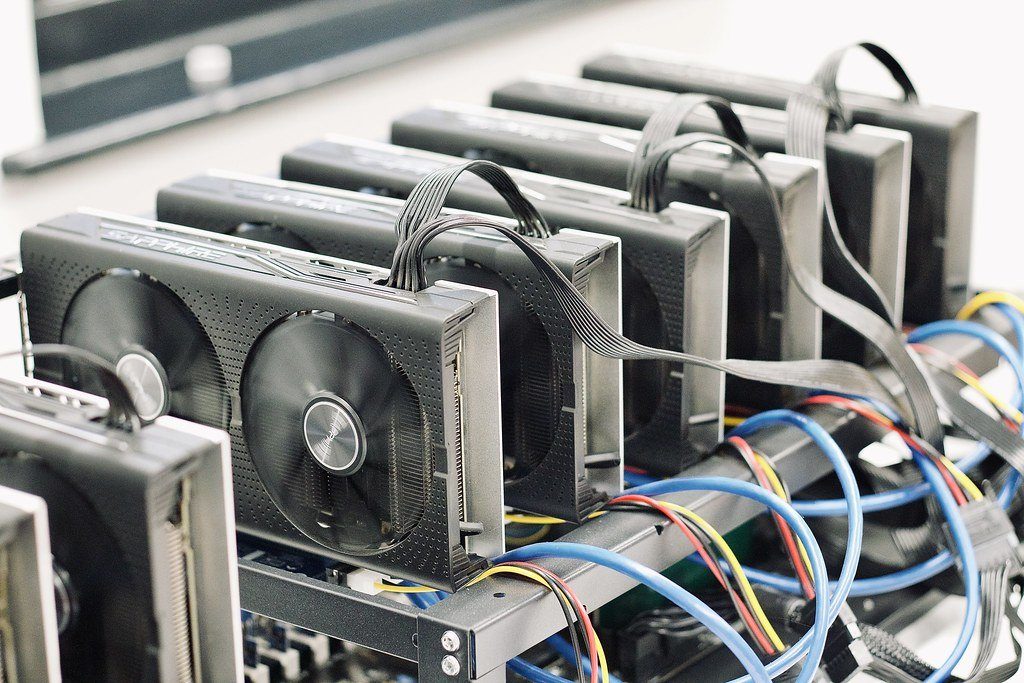
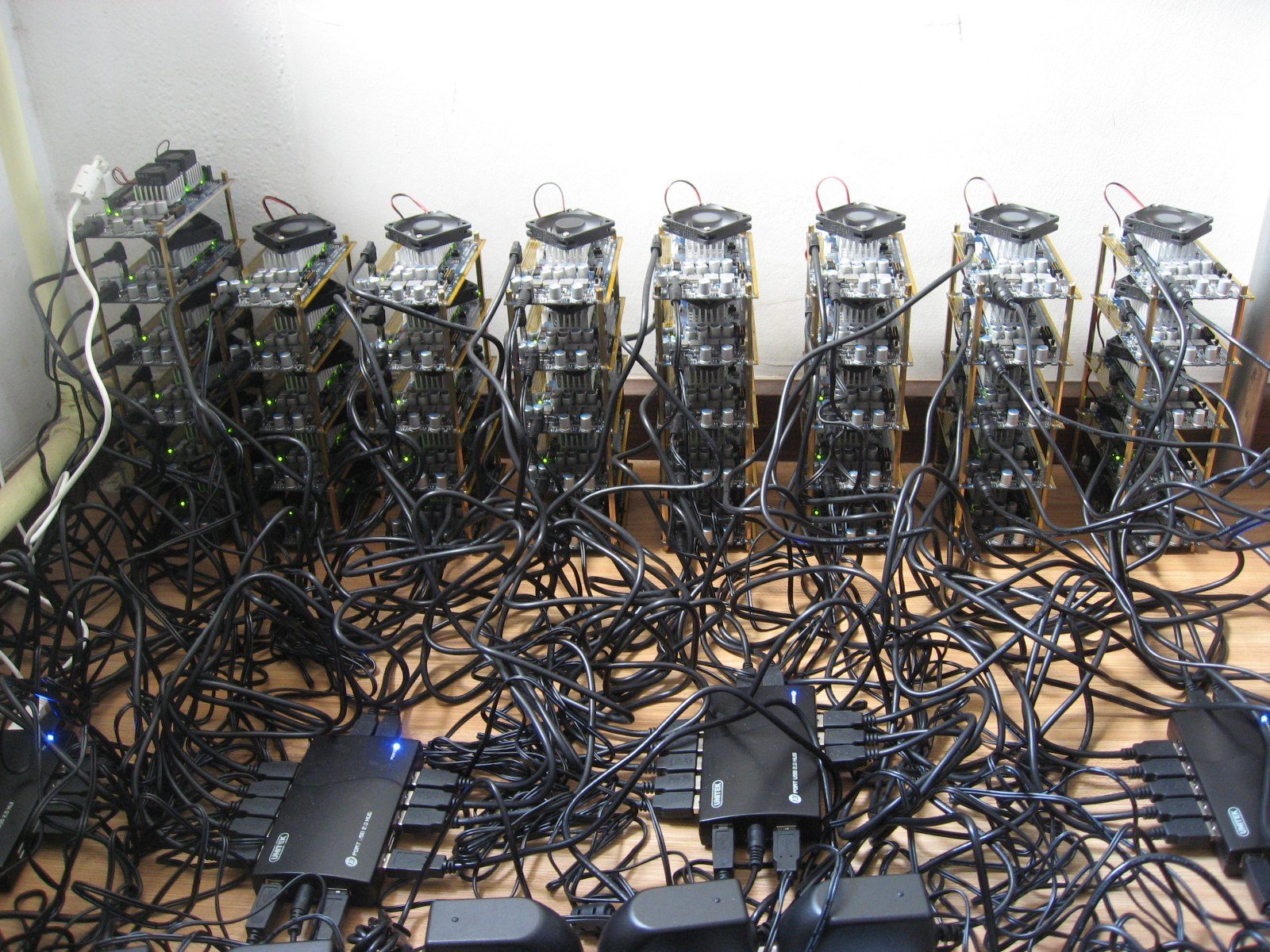
Not an ordinary laptop. The EIA says: “Investors in proof of work cryptocurrency mining make use of specialized hardware that can perform many trillions of calculations a second.”
NIST’s summary of proof-of-work drawbacks names three: it is computationally intensive by design, it consumes a lot of power, and it drives a “hardware arms race”. As more computing power joins the network, the difficulty adjusts upward to keep blocks about 10 minutes apart.
Because a single machine wins blocks rarely, many miners combine forces. NIST notes: “For many proof of work based blockchain networks, publishing nodes tend to organize themselves into “pools” or “collectives” whereby they work together to solve puzzles and split the reward.”
How much electricity does crypto mining use?
A lot, though the estimates are uncertain. In February 2024 the EIA wrote: “Our preliminary estimates suggest that annual electricity use from cryptocurrency mining probably represents from 0.6% to 2.3% of U.S. electricity consumption.” It had identified 137 mining facilities in the US at that point.
The EIA also says electricity is the primary operating cost of a mining facility, needed both to run the machines and to cool them. It stressed the uncertainty: one outside estimate it cited put Bitcoin mining’s power demand at the end of January 2024 at 19.0 GW, with a range from 9.1 GW to 44.0 GW. The EIA asked for emergency approval to survey US miners directly to get better numbers.
Not every blockchain mines. Ethereum switched from proof of work to proof of stake on 15 September 2022, and ethereum.org estimates its energy use fell by more than 99%. Our Ethereum guide explains the change.
Can I mine crypto at home?
Technically anyone can run mining software. Whether it covers its costs is a different question, and we have no primary source that answers it for you. What the EIA’s description makes clear is the competition: specialised machines running trillions of calculations a second, with electricity as the main expense.
If you are thinking about it, do the arithmetic with your own figures: the hardware price, your electricity tariff, the machine’s power draw, pool fees, and the fact that difficulty and the block reward both change over time. Treat any seller’s profit projection as marketing, not data.
What are the risks of mining offers and cloud mining?
One trap to know about has nothing to do with hardware: buying a “mining contract” from someone else. The US Securities and Exchange Commission (SEC) has brought cases like these:
- GAW Miners and ZenMiner (2015). The SEC charged the companies and their founder with running a Ponzi scheme. It said their “Hashlet” contracts were “touted as always profitable and never obsolete”, and that “most investors paid for a share of computing power that never existed.”
- Mining Capital Coin (2022). The SEC alleged the company “sold mining packages to 65,535 investors worldwide and promised daily returns of 1 percent, paid weekly, for a period of up to 52 weeks.” As illustrative arithmetic, 1% a day for 364 days is a promised 364% simple return in a year — the kind of number that should stop you.
These are the SEC’s allegations as announced; they show the pattern to watch for. Promises of “guaranteed” high returns, unsolicited pitches and pressure to buy right now are red flags listed by the US Commodity Futures Trading Commission (CFTC) and the SEC. Read our crypto scam red flags guide before paying anyone to mine for you.
Owning the coins mining produces carries the usual crypto risks too. The UK Financial Conduct Authority (FCA) says crypto-assets “are all high risk and speculative as an investment”.
Blockhorizon is an education site. Nothing here is a recommendation to mine, buy or sell any crypto-asset.
Frequently asked questions
Is crypto mining the same as buying crypto?
No. Mining means running computers that compete to add blocks and earn the block reward. Buying means paying someone for coins that already exist.
Do all cryptocurrencies use mining?
No. Mining belongs to proof-of-work networks such as Bitcoin. Proof-of-stake networks, including Ethereum since September 2022, choose block producers based on staked coins instead.
What is a mining pool?
A group of miners who combine their computing power and split the reward. NIST describes publishing nodes organising into “pools” or “collectives” to solve puzzles together.
Is cloud mining a scam?
Not every offer is, but the SEC has charged mining-contract schemes, including one where most investors paid for computing power that never existed. Any offer of fixed daily returns from mining is a red flag.
Article Sources
11 sources
Blockhorizon checks every figure, date and quotation against primary sources: regulators, statistics bodies and original technical documents. Read our editorial policy.
- NIST IR 8202, Blockchain Technology Overview (2018) — nvlpubs.nist.gov (accessed 2026-10-02)
- US Energy Information Administration, Tracking electricity consumption from U.S. cryptocurrency mining operations (1 Feb 2024) — eia.gov (accessed 2026-10-02)
- Satoshi Nakamoto, “Bitcoin: A Peer-to-Peer Electronic Cash System” (whitepaper) — bitcoin.org (accessed 2026-10-02)
- Bitcoin Core source code — validation.cpp, GetBlockSubsidy() — github.com (accessed 2026-10-02)
- Bitcoin Core source code — kernel/chainparams.cpp (mainnet parameters) — github.com (accessed 2026-10-02)
- Bitcoin.org — Frequently Asked Questions (transaction fees) — bitcoin.org (accessed 2026-10-02)
- ethereum.org — The Merge — ethereum.org (accessed 2026-10-02)
- SEC press release 2015-271, SEC Charges Bitcoin Mining Companies (1 Dec 2015) — sec.gov (accessed 2026-10-02)
- SEC press release 2022-81, SEC Halts Fraudulent Cryptomining and Trading Scheme (6 May 2022) — sec.gov (accessed 2026-10-02)
- CFTC & SEC, Investor Alert: Watch Out for Fraudulent Digital Asset and “Crypto” Trading Websites (2019) — cftc.gov (accessed 2026-10-02)
- UK Financial Conduct Authority, Crypto: the basics (updated Jan 2026) — fca.org.uk (accessed 2026-10-02)