News analysis ·
Block's Dessa voice AI and crypto scams: what to check
Block's Dessa voice AI sounds human, and critics fear scam calls. How voice fraud targets crypto users, and the checks that still work.
Block, the payments company led by Jack Dorsey, has shown a voice AI called Dessa that sounds very close to a real person, CoinDesk reported. Some listeners were amazed; others warned that phone scams could become much harder to spot. This article looks at why a humanlike voice matters for crypto users, and which safety checks still hold when you can no longer trust your ears.
What Block showed
According to CoinDesk, Dessa was trained only on recorded human speech, not on text. It can keep listening while it talks. That lets it handle interruptions, laughter and changes in tone the way people do in a real conversation. In one demo clip, the model laughs in the middle of a sentence. Block says the demo conversations were recorded live, with nobody steering the answers.
Most voice assistants work in steps. They turn your speech into text, write a reply, then read that reply aloud. Dessa skips the text step and works on audio directly. Block said it trained the model from scratch on a single Nvidia GB200 NVL72 system, and that it is small enough to run on a MacBook Pro with an M4 Max chip or better.
For now, Dessa is a research preview. The public cannot use it. Block is letting a limited group of outside safety researchers test it first, to look for risks the company may have missed.
Why critics talk about crypto scams
Crypto scams are schemes that trick you into sending coins, sharing a login code or revealing your seed phrase, the list of words that controls a wallet. Some start with a call. The caller pretends to be exchange support, a bank, a police officer or a relative in trouble. The goal is always the same: rush you into acting before you think.
Many people rely on a flat tone or an odd pause to sense a fake voice. A model that laughs, hesitates and reacts with emotion makes that clue less useful, if the demos are typical. Filmmaker Justine Bateman asked what purpose a human-sounding machine serves. Her answer, as quoted by CoinDesk: "So you can trick people into lowering their guard". Journalist Shiv Aroor wrote on X that scam calls could soon reach pandemic level.
Not every reaction was negative. Binance founder Changpeng Zhao saw a possible use in education, linked to his GiggleAcademy project. Block itself argues that speech models may one day pick up signals such as distress or pain that a text transcript loses.
Why a natural voice is the wrong thing to trust
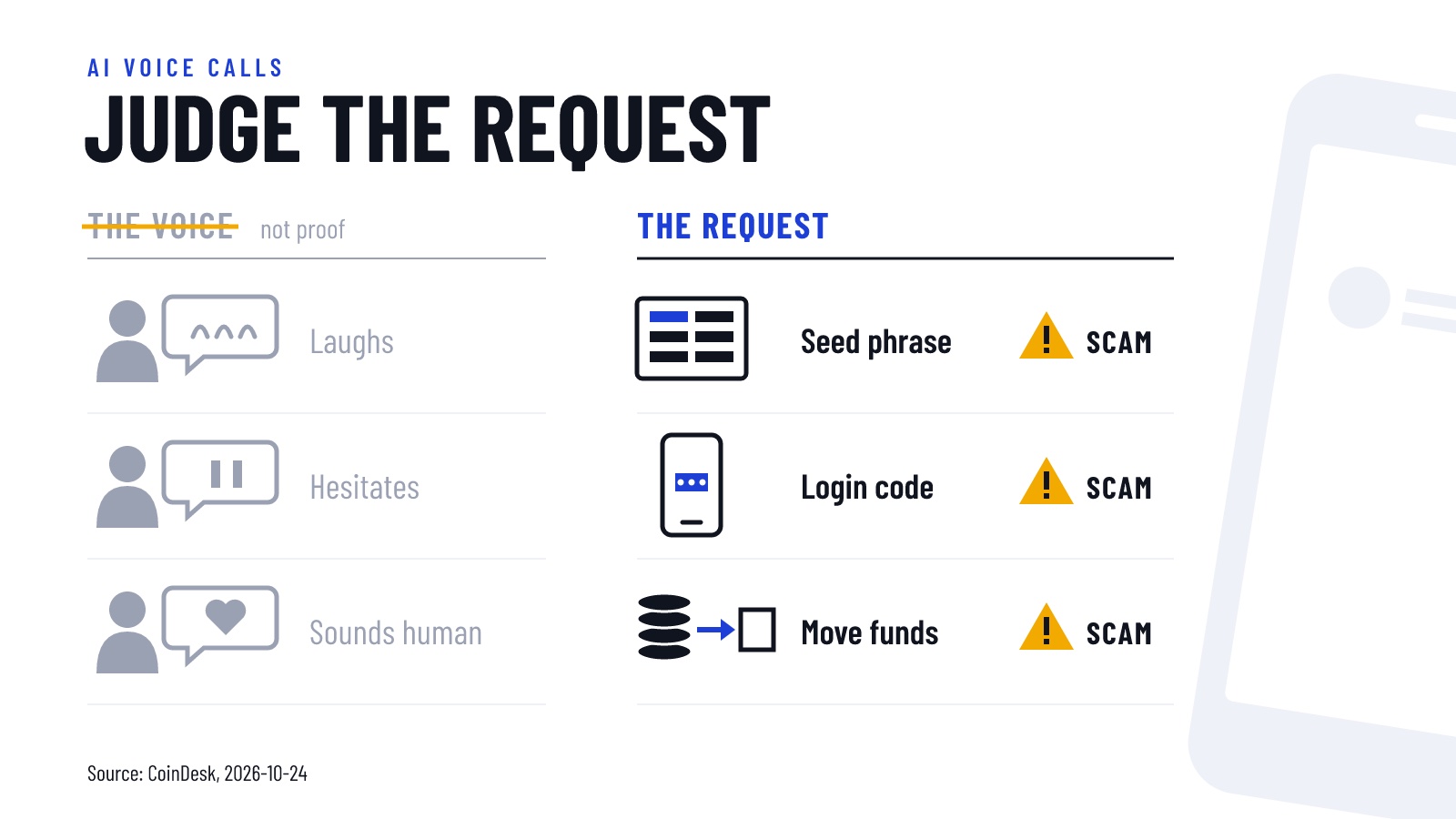
The Blockhorizon lesson here is simple: how a voice sounds was never proof of who is speaking. Scammers already copy caller ID, email addresses and company logos. A realistic voice is one more layer of costume. The safe approach is to judge the request, not the voice.
Real exchanges and wallet makers follow a few fixed rules. They do not ask for your seed phrase or private key. They do not ask you to read out a login or withdrawal code. They do not ask you to move funds to a new safe address. Any call that asks for one of these things is a scam, however friendly or upset the caller sounds. The same goes for a family member who calls in a panic and needs crypto sent right now.
What this means for your own accounts
These checks do not depend on spotting a fake voice, so they keep working as voices improve.
- Hang up and call back yourself, using the number or chat inside the official app or website, never one the caller gives you.
- Never share a seed phrase, private key, password or one-time code on a call, whoever claims to be asking.
- Agree a private question or code word with close family, so an urgent money call can be checked in seconds.
- Treat pressure as the red flag: a deadline, a threat that your account will be frozen, or a demand for secrecy all mean stop and verify.
It also helps to protect the phone number itself. If someone takes over your number, they can receive your login codes. Using an authenticator app instead of text message codes, where your exchange allows it, reduces that risk.
What is still unknown
Much about Dessa has not been shared. Block has not disclosed the model size, benchmark scores or a release date. The audio clips are company demos, not independent tests, so it is not yet clear how the model performs outside Block's own recordings.
It is also not known what limits Block will place on the model if it is released, or what the outside safety researchers will find. Block runs Square, Cash App, the bitcoin wallet Bitkey and the mining hardware unit Proto, and its AI lab reports directly to Dorsey. The lab includes former staff of a Toronto startup also called Dessa, which Square bought in 2020. For users, the practical point does not change: any voice can now sound real, so the request, not the speaker, is what you check.
Sources
- CoinDesk, 24 Oct 2026
This safety brief was drafted by AI from the reports cited above and published automatically once our checks passed (figures matched to sources, no copied sentences). No person reviewed it before publication. It is general safety information, not advice on what to buy or sell.