News analysis ·
Brooklyn shuts fake crypto trading sites: the red flags
Brooklyn prosecutors and the FBI disrupted 241 fake trading sites aimed at Russian speakers. How the scam and its recovery follow-up worked, and what to check.
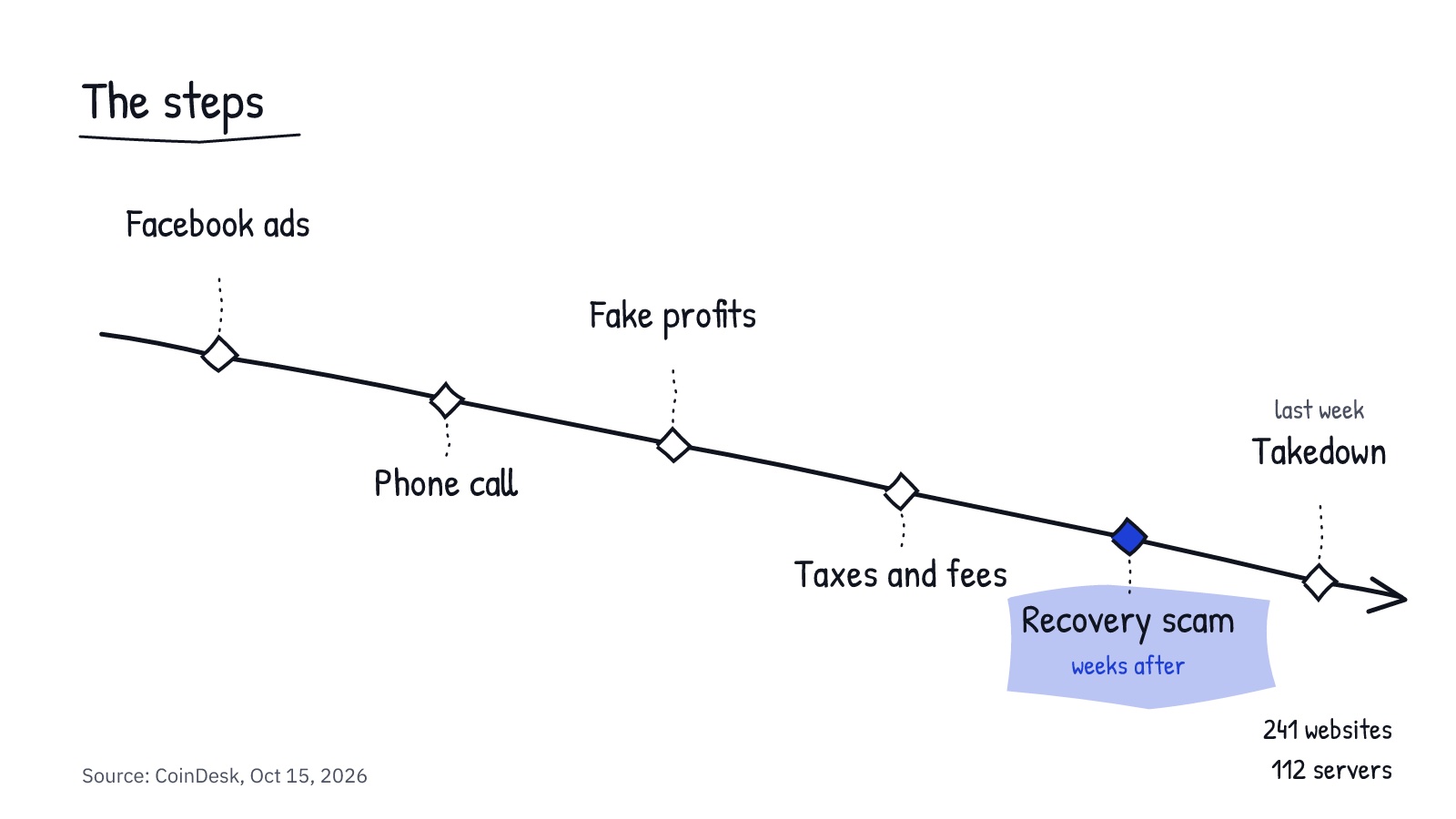
Brooklyn prosecutors, working with the FBI, have taken apart a crypto investment fraud network that targeted Russian-speaking people in the US. According to CoinDesk, 241 websites and 112 servers were seized or knocked offline. This article looks at how the scheme moved money out of victims' hands, why the same group came back a second time, and which warning signs an ordinary crypto user can check for.
What happened
The action was led by the Virtual Currency Unit of Brooklyn District Attorney Eric Gonzalez, with help from the FBI. CoinDesk reported that the takedown took place last week, after an investigation that lasted three years. No arrests were announced.
The network is alleged to have taken tens of millions of dollars. Protos said the domains and servers were spread across Ukraine, Eastern Europe and America, and quoted a description of the case as among the largest cyber disruption operations ever run by a local prosecutor's office. So far about $300,000 has been seized, and officials plan to claw back more. According to prosecutors, a number of victims had their entire savings wiped out.
How the fake platform worked
The scheme followed a pattern that safety teams see again and again. It started with Facebook ads in Russian that offered investment opportunities. Protos described the bait as a fake forex investment site promising large returns. Forex means trading one currency against another.
Next came a phone call. Fake advisers, according to CoinDesk, coached people to buy cryptocurrency and send it to trading platforms that the scammers controlled. A trading platform here is simply a website that shows an account balance and lets you place trades. Anyone can build one that looks professional. The numbers on the screen are whatever the operator types in.
That is why victims saw profits, as Protos reported. The gains were fabricated. The crypto had already left the victim's control when it was sent. When people asked to withdraw, the sites froze their accounts or asked for more money, described as taxes and fees.
The second scam: a promise to get the money back
The harm did not stop there. Data recovered by investigators showed that the same group got back in touch with victims weeks after the first theft and offered to retrieve the lost funds. Gonzalez said the scammers "tried to exploit them again with false promises to recover their money".
This is known as a recovery scam. It works because a person who has just lost money is desperate for a fix. The caller often knows details of the first loss, which makes the offer feel real. This time investigators went after the servers that held victim data, not only the websites.
What this means for your own accounts
The lesson from this case is about the steps, not the brand names. Each stage of the scheme is a checkpoint where a user can stop. Before sending crypto anywhere after an ad or a call, run these checks:
- Treat any unsolicited adviser who tells you to buy crypto and send it to a specific platform as a red flag, however friendly or fluent the call is.
- Check whether the platform is authorised by a financial regulator in your country before depositing, and find it yourself rather than through a link from the caller.
- A request to pay a tax or fee before you can withdraw is a strong sign the balance is not real. Do not send more money to unlock money.
- If someone offers to recover lost crypto for an upfront payment, assume it is a second scam and report it to the police and the FBI instead.
Crypto carries real risk, and you can lose money you send to any platform, genuine or fake. Money sent to a scam is rarely returned. A service that makes withdrawing hard is telling you something important.
Why one takedown does not end the risk
CoinDesk noted that the DA's unit had earlier taken down or disrupted 400 crypto fraud domains, yet new sites kept appearing. Websites are cheap to replace. This time, investigators targeted the servers that stored victim data and the fraud software, hosted by Eastern European and US companies, to make quick relaunches harder.
The wider numbers show why this matters. FBI annual report figures cited by CoinDesk show that in 2025 crypto investment scams were roughly 84% of reported investment-fraud losses, which totaled $8.65 billion. Across all internet crime, CoinDesk put crypto-linked losses at $11.37 billion out of $20.88 billion, about 54%.
What is still unknown
No arrests were announced, so it is not clear who ran the network or whether the people behind it can rebuild elsewhere. The full loss has only been described as tens of millions of dollars. It is also unclear how much of the money victims will see again beyond the roughly $300,000 seized so far.
Sources
This safety brief was drafted by AI from the reports cited above and published automatically once our checks passed (figures matched to sources, no copied sentences). No person reviewed it before publication. It is general safety information, not advice on what to buy or sell.