News analysis ·
Musk deepfake crypto scam: Coinbase blocks $4.7 million
A fake Musk livestream promised to double crypto. Coinbase says it blocked $4.7 million. How the scam works and what to check before you press confirm.
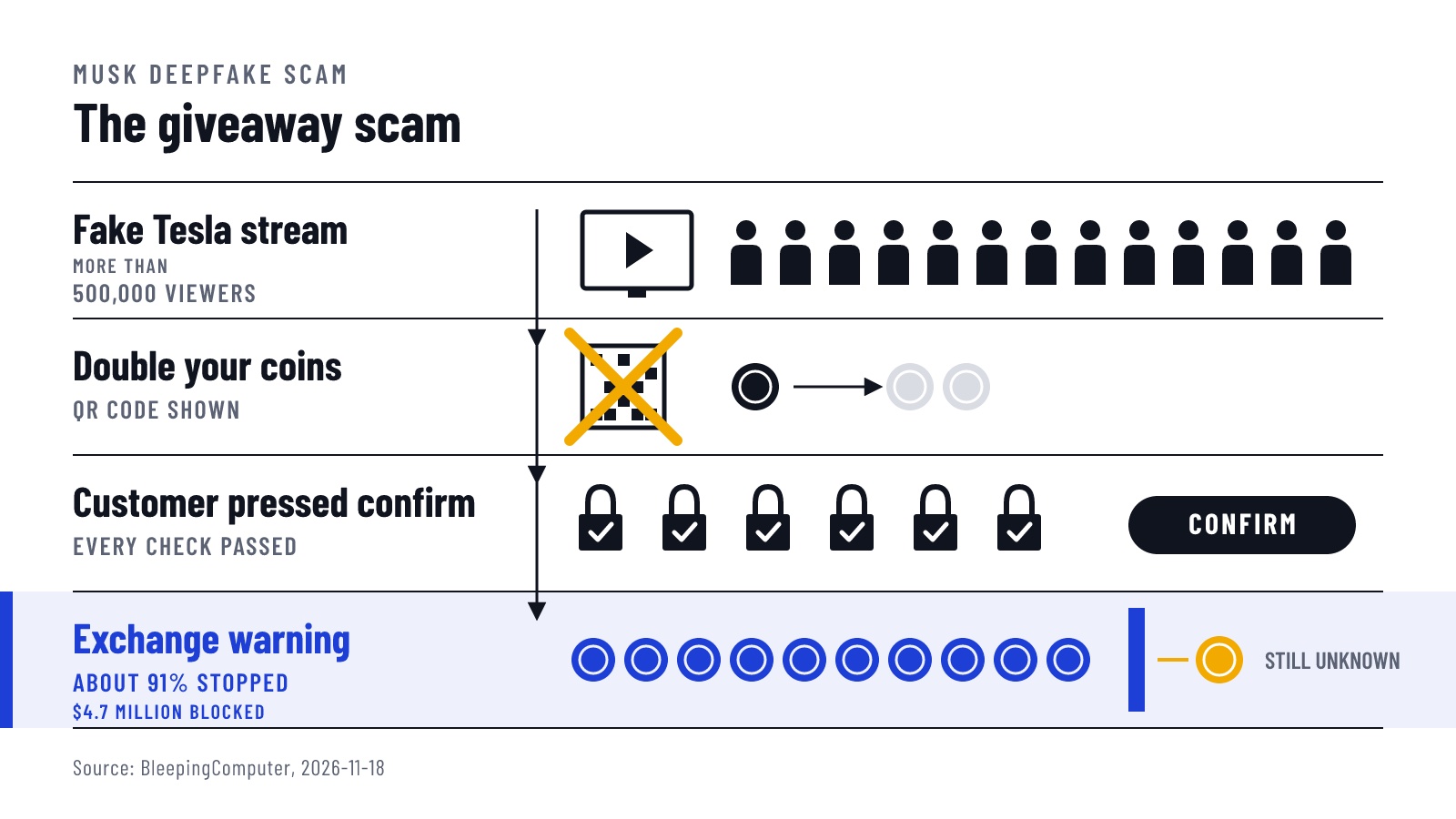
Coinbase says it stopped $4.7 million in crypto transfers that its customers tried to send to a fake giveaway built around an AI deepfake of Elon Musk, BleepingComputer reported on 2026-11-18. Nobody's account was hacked. People sent the money themselves, because a video told them to. This article looks at why that kind of scam works, and the checks that matter when the danger is your own finger on the confirm button.
What happened during the fake Tesla stream
Scammers set up a counterfeit YouTube stream that looked like a broadcast of Tesla's flying car demonstration. According to BleepingComputer, the stream drew more than 500,000 viewers. On screen was an AI-made video of Musk, a set of wallet addresses and a QR code. The message was simple: send coins, and they come back doubled.
Coinbase said hundreds of its customers tried to send millions of dollars to the scam over roughly two hours. Many were long-standing users, not newcomers. The exchange said its fraud systems caught the campaign and stopped about 91% of the attempted transfers, a total of $4.7 million.
How do crypto scams like this work?
A giveaway scam does not break into anything. It persuades you to send money on your own. A deepfake is a video or voice generated by AI to look and sound like a real person. Here it borrowed the face of a famous founder and the timing of a real product event, so the fake felt like part of the show.
The trick rests on three pressures. First, a promise to multiply your coins. Second, a live event that seems to end soon, so you feel you must act now. Third, a crypto transfer that cannot be reversed once it is sent. Coinbase named exactly these patterns when it explained how its system spotted the campaign.
This is why such scams are hard for any platform to catch. Most security tools look for logins or payments the owner did not approve. In this case the owner did approve them. As Coinbase put it: "The customer was logged in, the customer pressed confirm, and the customer believed it was the opportunity of a lifetime."
Why a strong password did not help
Many beginners think crypto safety means a good password and two-factor login. Those protect against someone else entering your account. They do nothing when you are the one sending the funds. Every check passed, because the real owner was at the keyboard.
Coinbase described a different layer. Its system uses machine learning to score outgoing transfers as they happen, looking for giveaway patterns, brand impersonation and brand-new destination wallets. When a transfer looks wrong, an AI agent starts a short chat, describes the suspected scam and asks questions meant to help the customer see it. Coinbase said the agent had never met this specific campaign, and that the whole process ran automatically with no staff involved.
That safety net is useful, but it is not a promise. It only works on the platform that runs it, and by Coinbase's own figures some attempted transfers were not stopped. A wallet you control yourself, or a smaller app, may have no such check at all. The last line of defence is your own pause before sending.
What this means for your own accounts
Musk and his companies have long been used as bait. BleepingComputer noted hijacked verified Twitter accounts, fake giveaway emails and floods of TikTok promotions, and a separate scheme with compromised verified Twitter accounts that took more than $580,000 in a single week. Expect the same name to return in new forms. These checks apply whatever face appears on screen:
- Treat any offer to double or multiply crypto you send as a scam. No real company or founder runs giveaways that ask you to pay first.
- Never scan a QR code or copy a wallet address from a video, livestream or comment. Check the offer on the company's official website and official social accounts, as BleepingComputer advised.
- If an exchange warns you or asks questions about a transfer, stop and read it. A warning that interrupts you is the moment to walk away, not to click past.
- Notice urgency. A countdown, a live event or a limited number of slots is a pressure tactic. A real offer will still be there after a short pause.
If you have already sent funds, report it to your exchange at once. Be wary of anyone who then offers to recover the money for a fee.
What is still unknown
The key number is missing. BleepingComputer asked Coinbase for the count of payments that got through and the total value lost, and had no answer at the time of reporting. It is also not known how many viewers sent money from other exchanges or from their own wallets, where no screening may have taken place.
Sources
- BleepingComputer, 18 Nov 2026
This safety brief was drafted by AI from the reports cited above and published automatically once our checks passed (figures matched to sources, no copied sentences). No person reviewed it before publication. It is general safety information, not advice on what to buy or sell.