News analysis ·
Q3 crypto hacks cost $1.18 billion: what audits miss
Hacken counts $1.18 billion stolen in Q3 crypto hacks, much of it from weak spots audits can miss. What an audit badge covers and what users can still check.
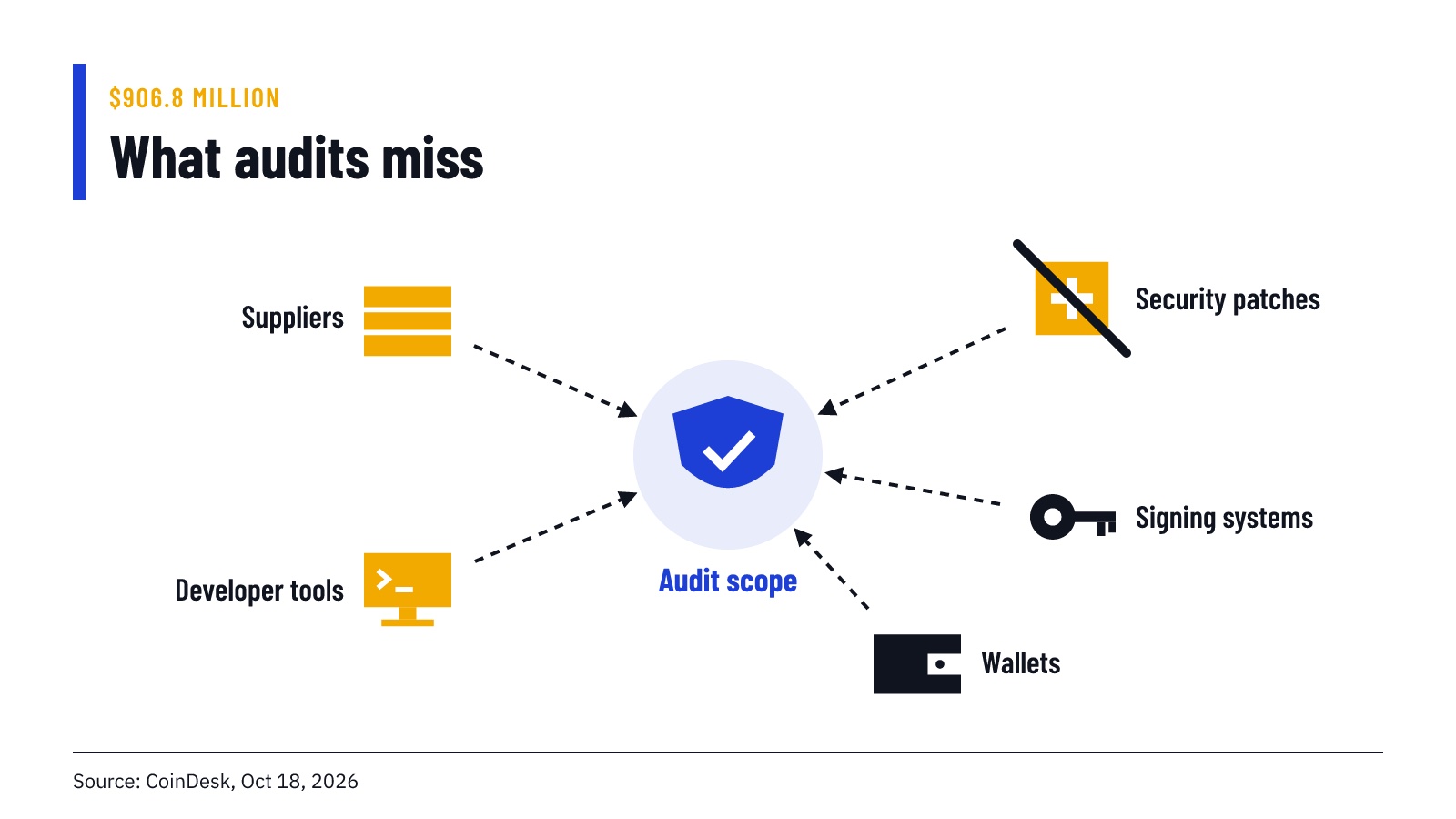
Hackers took $1.18 billion from crypto platforms in 107 incidents during the third quarter, according to a report from blockchain security firm Hacken covered by CoinDesk. Hacken said $906.8 million of it came from weak spots such as suppliers, missed patches and parts left out of the latest review. This article looks at what an audit badge really protects, and what an ordinary user can still look at before trusting a platform.
What Hacken found in the third quarter
Hacken said Q3 losses were 55% higher than in the quarter before. The firm traced $906.8 million of the total to three kinds of weak spot: compromised suppliers or developer tools, known security patches that were never installed, and parts of a system that were left out of the latest security review.
The largest single case was a September attack on the exchange Bitget. The report put its loss at no less than $352 million. According to Hacken, the attackers used a flaw in a third-party security product to reach the exchange's withdrawal systems, the machinery that moves customer coins out.
Exchanges were not the only targets. Liquid Network lost $319 million, the report said. Tectonic lost at least $75 million, and Coldcard wallet software lost roughly $114 million. In July, a six-hour exploit hit three bridges and cross-chain protocols for more than $35 million. AFX Trade alone lost $24 million after attackers took control of its validator keys. CoinDesk also noted that Ledger said this week a device sold by the Southeast Asian reseller CryptoBilis carried an unauthorized spy implant, with losses of about $93 million.
Is a crypto exchange safe if it says it is audited?
Not automatically. An audit is a paid review of a defined set of code, and that set is called the scope. Hacken said users often read an audit as covering a whole platform, while it may only check certain smart contracts, the programs that run on a blockchain. Wallets, signing systems and outside software can sit outside the review.
Hacken co-founder and board director Andrii Matiukhin told CoinDesk that full audit scopes are costly, so teams trim them and review only the most critical pieces. "The problem is always scope." In the Bitget case, the weak point Hacken named was a security product from another company.
How the attacks get around the audit
Think of a platform as a building. An audit may inspect the vault door very carefully. But attackers came in through a supplier's entrance, a window with a known broken latch, or a room that nobody was asked to inspect. That is what supplier compromise, missed patches and out-of-scope components mean in practice.
Matiukhin also flagged slow patching. When several blockchains share one codebase but update it on different schedules, a fix in one place can leave another exposed. He said teams sometimes rate a critical flaw as low, which delays the repair.
Keys are another weak spot. Hacken studied 12 derivatives venues and prediction markets. At two large ones, over $700 million depended on a three-of-four key signing setup, where three of four keys must approve a transfer, or on admin keys held by unnamed people. Matiukhin said Hacken saw no sign of a live bug, but judged some key setups too weak for the sums involved.
What this means for your own accounts
You cannot audit an exchange yourself. You can still treat a badge as one small signal rather than a promise, and limit how much rides on any single platform.
- When a platform says it is audited, look for what the audit covered and when it was done. A review of a few contracts from long ago says little about wallets or withdrawal systems today.
- Keep only what you actively use on an exchange. Coins held there depend on the exchange's own keys and suppliers, not on you, and money lost in a hack may not come back.
- If you hold coins yourself, buy hardware wallets only from the maker or a source you can verify, and check the device before you load it.
- Watch for news of a hack or paused withdrawals at any platform you use, and do not respond to messages offering to recover lost funds, a common follow-up scam.
Hacken's own conclusion points the same way: it said firms that hold customer funds carry the responsibility to track flaws and patch quickly instead of leaning on an old audit.
What is still unknown
Matiukhin would not name the two venues with weak key setups, so users of derivatives platforms cannot tell from the report whether their own venue is one of them. The report, as described by CoinDesk, also does not say how much of the stolen money has been recovered or how each platform is treating affected customers. Those answers will come, if at all, from the platforms themselves.
Sources
- CoinDesk, 18 Oct 2026
This safety brief was drafted by AI from the reports cited above and published automatically once our checks passed (figures matched to sources, no copied sentences). No person reviewed it before publication. It is general safety information, not advice on what to buy or sell.